Total Pageviews

Showing posts with label Pepsi. Show all posts

January 05, 2018

Name sake Competitors or Partners Planning for Market Domination!


Marketers always talk of competitors as being fierce and at each other’s throats. There is a saying "everything is fair in war and love". But is not really true. Most of it is only sparring. Check out what is happening on TV.

India Vs South Africa cricket series is playing out in South Africa and all other sports channels will try to divert our attention to their own programmes. They will show any other cricket match that is as close to India vs South Africa match as possible. Not that the viewers get confused easily, but it is par for the course.

Star Sports and Star Cricket are desperately trying to milk their contract with IPL for the next five years. They already have had prelude for the IPL auctions for 2018 season. They will try to prolong the auction process and the aftermath as much as possible. Trying to milk IPL when the Indian national team is playing does not cut much ice with the audience.  But they have nothing to lose and everything to gain, right!

But the TV channels are not really competitors! When one channel takes a commercial break – check out any other similar channel. All of them will be playing commercials. So as far as getting money from the advertisers all of them are on the same platform or frequency!


Most competition simply, is at the vey basic level and it is to get market share. Most companies maintain some sort of a status quo. When a huge controversy erupted in 2006 about presence of pesticide in Indian soft drinks, both Pepsi and Coca-Cola’s CEOs came on the same platform to address a joint press conference!


Yes, you have read it right! Pepsi and Coke on the same platform. And both companies proudly say in their advertisements that the cola wars are on and that they would not even utter each other’s names!


There was lot of back patting in that press conference and both the CEOs in unison were very magnanimous in declaring that their colas are absolutely safe. They finally hinted not so subtly that it is actually the contaminated ground water of India that is responsible for the pesticide in the colas and not their production process or their ingredients! And we continue to patronize the colas! Caveat Emptor! 

September 14, 2014

My 500th posting - Strange and fascinating facts about marketing!


1) Why does a watch advertisement  always show 10:10. All of us have wondered many times why watches and clocks found in product photographs and advertisements mostly show the time 10:10? The main reason is aesthetics. There are a number of visual advantages of having the hands of the watch set at the 10:10 positions.

One is that the hands are kept from overlapping. Having them on both sides of the watch face ensures that the hands themselves are visible and can be appreciated. There is symmetry and beauty in the presentation. The position also allows the hands to look nice on the face of the timepiece.

Another reason is that key details on the face of the watch or clock usually remain visible at 10:10. The logo of the manufacturer is usually found under the 12, and sometimes next to the 3, 6-, and 9 o’- clock positions. Logos found under the 12 are nicely framed or centered by 10:10 hands.

The 10:10 hands look “happy” due to the fact that the hands look like a smile (or like a “V” as in “victory”). Timex once used to use the time 8:20 in their product photos but 8.20 was perceived as a frown, and Timex decided to turn that “frown” upside-down or go back to 10:10.

There are a number of other beliefs about the 10:10 time. Many of them attribute it to a historic event (e.g. Lincoln/JFK assassinations, the dropping of the atomic bombs) but most of the beliefs are unsubstantiated by facts.  

2)  Why a Baker’s Dozen, 13 Instead of 12. There are two main theories for why a baker’s dozen is 13 instead of 12, but most think it has its origins in the fact that many societies throughout history have had extremely strict laws concerning baker’s wares, due to the fact that it is fairly easy for bakers to cheat patrons and sell them less than what they think they are getting. In Babylon, if a baker was found to have sold a “light loaf” to someone, the baker would have his hand chopped off.

Why would the bakers give 13 and charge for 12? There are two theories. The first is that bakers would sell 13 loaves to vendors, while only charging them for 12 which allowed the vendor to then sell all 13 at full price; thus, they’d earn a 7.7% profit per loaf.  

Yet another theory is that it was simply a product of the way bakers bake bread.  Baking trays tend to have a 3:2 aspect ratio.  The most efficient two-dimensional arrangement then of loaves/biscuits/whatever on such a tray results in 13 items with a 4+5+4 hexagonal arrangement, which avoids corners.  

It was important to avoid the corners because the corners of a baking tray will heat up and cool off faster than the edges and the interior, which would result in not cooking anything on the corner evenly with the rest.  But this theory doesn’t explain why they’d sell them in batches 13 for the price of 12, but at least explains why they may have commonly made them in batches of 13.  

3) Video games maker EA hired people to accuse EA being the Anti-Christ for the video game Dante’s Inferno as a marketing scheme. Nothing makes news like a controversy to garner additional eyeballs.


4) Jell-O monitored the amount of smiley faces and frown faces used on Twitter. Whenever the national average of smiley faces was more than 51%, Jell-O released coupons to those who recently tweeted frown faces. Talk about targeted marketing!

5) Kraft Foods rotated their square Shreddies cereal 45 degrees, and re-marketed them  as the new “Diamond Shreddies”. The new product showed a large increase in sales and test groups even reported a difference in flavor. This shows us how it is all about how things are marketed to us.

6) Total War-Rome: Rather than use the marketing budget on advertisements for Total War-Rome, the game developers hired a group to create (entertaining) Youtube videos about the Punic Wars and Roman History. They suggested this group not mention or market the game, “Just teach history”.

7) LendUp: It is possible that loans  could be refused in USA if the person is unpopular on the Facebook. A San Francisco based start-up LendUp checks the Facebook and Twitter profiles of potential borrowers to see how many friends they have and how often they interact. The company views an active social media life as an indicator of stability.

8) web app: The web app now pulls data for people on social media sites. It crunches all of the information, highlights topics where people are most influential, and generates a score for everyone between 1 and 100. The higher the score, the more influential a person is. Marketers use these scores to target their advertisements to industry leaders.

9) Pepsi ran an advertisement promising a Harrier jet to anyone who collected 700,000,000 Pepsi Points, a gag that backfired when a participant attempted to take advantage of the ability to buy additional points for 10 cents each to claim a jet for $700,000.

10) Joanne Rowling, better known by her initials J K, does not have a middle name, according to her birth certificate. The use of the author’s initials instead of her full name was a marketing ploy designed to make her work acceptable to boys, who mostly choose not to read books by women.

July 19, 2014

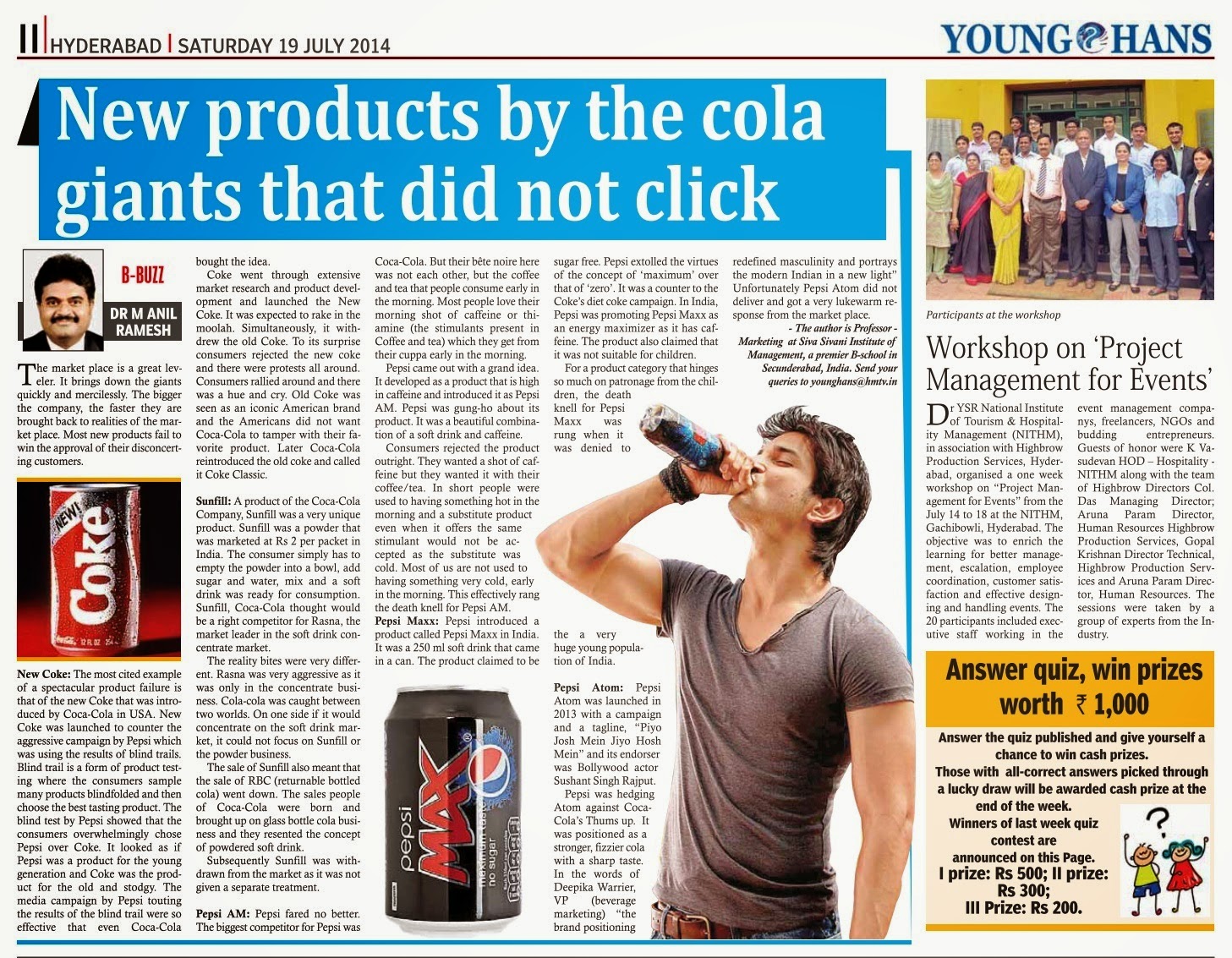
10th article published in HANS INDIA - "New Products from the Cola giants that failed to make a cut"

10th article published in HANS INDIA today (19th July 2014). It is an article about "New Products from the Cola giants that failed to make a cut". Incidentally the photograph next to my article features Prof P. Narayana Reddy (wearing tie). Prof P.Narayana Reddy was my first HOD in academics and he is my PhD guide, guru and mentor. It is a honour sharing media space with him. I am delighted.


April 26, 2013

Second Time lucky for Pepsi ? - Pepsi Atom Introduction after the Pepsi Maxx disaster


Pepsi did it again. On Thursday 25th April 2013, Pepsi India introduced its second brand of Cola – Atom. Pepsi wants to cash in on the summer rush and also add weight to its product sales by piggybacking on the hype and popularity of the IPL cricket tournament. It believes it has a winner in hand – and its name Pepsi Atom.

Pepsi Atom will be available across the country in various packages including a 250 ml can at an introductory price of Rs 15 and a 500 ml PET bottle at Rs 25 and a  200 ml returnable glass bottles (RGB) which will be available in select markets at Rs 10.

Pepsi is sitting pretty in India. It outsells Coca-Cola but still Coca Cola sells better than Pepsi overall in the cola market as it has strong winners from the through bred winners that it bought over  from the competition.  These are the brands that Cola-Cola bought from Ramesh Chauhan of the Parle group – especially Thums Up. Thums Up is a out right winner. It outsells both Coke and Pepsi in India.

Pepsi must be kicking itself for not considering buying Thums up before Coca-Cola. They had all the chances. Pepsi moved into India the second time in 1989, four years before Coke. But the top guys at Pepsi must have felt that Thums up would pose a challenge to Pepsi itself. Whatever it was it proved to be a decisive mistake. Pepsi along with Thums Up would have sounded the death knell for Coca-Cola in India.

But that is all water under the bridge. Pepsi wants to counter Coca-Cola in all segments. It brought in Pepsi Maxx a zero calorie drink in August 2010 to counter Diet Coke and failed miserably. Now Peso is firing the next salvo.

Atom will be launched with a campaign and a tagline: “Piyo Josh Mein Jiyo Hosh Mein” and its endorser will be Bollywood actor Sushant Singh Rajput.

Pepsi is hedging Atom against Coca-Cola’s Thums up.  It is being positioned as a stronger, fizzier cola with a sharp taste. It is going to be a all-out war. The knives are out, already. Check out the words of Deepika Warrior, VP-President (beverage marketing) “the brand positioning redefines masculinity and portrays the modern Indian in a new light”

She goes on to say "The atom  campaign would be more relevant and projects relatable definition of masculinity as opposed to much hyped mindless action”

No prizes for guessing whom she meant by “much hyped mindless action (Thums Up!)”. Watch this space in the coming days for more action.

September 01, 2012

Colours in Marketing!


Image credit: The Logo Company

Colours are exciting. Life without Colours would be very drab. We experience the world in Colour - Man is the only species that can see Colours. All other species see the world in black and white.

Thus it is not surprising that colours play a very significant role in the field of marketing. Most of the products and their packaging would be in the primary colours - Red, green and blue or a combinations of these three primary colours. Coca-Cola is predominantly red and Pepsi is blue and green is a Colour that symbolizes agriculture and is now the latest buzz is green field marketing or green marketing.

One other Colour that is very prominent in yellow. Yellow, Green and red are the colours that are used in traffic signals. Why these three colours? These are the colours that are attractive and visible from a distance. Precisely the reason why the golden arches of the McDonald are yellow. Yellow because they have to attract the travelers’ attention from long distance and induce them to stop.

Kodak too is heavily yellow. But as a marketer one needs to be careful about colours. Yellow is a very sacred colour in India. It is associated with the sun god.  

Colours have different symbolism in  different cultures. In South India white is seen as a sacred colour and white coloured clothes are worn for marriages and for holy occasions. But in the western part of India white is the colour of mourning.

I had worked in Ethiopia and once I wore a white flowing kutra pyjama to a college function. I was surprised at the reaction that I got. Many of my Ethiopian colleagues expressed their regret. I was shocked. On enquiry to my surprise I came to know that Ethiopians have the same custom as in the western part of India. White is for mourning. Talk of similarities of culture across the continents!

Similarly one needs to understand a culture before we try to assimilate ourselves into that culture. One US based company sent its senior executives to do business in Taiwan. The executives got off the plane wearing green caps. They conducted the entire day’s business wearing the green caps. Later that evening they returned to their Taiwanese hotel. The hotel manager almost fainted when he saw his US guests wearing green caps. He was laughing his head off. The crest fallen US business men were sheepish when they were told that in Taiwan wearing green hats by men signifies that the wearer’s wife has been unfaithful – unknowingly the US businessmen were going around the town proudly proclaiming that their wives have been unfaithful.

For the typical Taiwanese it made no sense at all. He could understand infidelity but why make a hue and cry about it. The behaviour of the US businessmen had left the Taiwanese stumped and bemused. Read more about colors in marketing at

https://www.helpscout.net/blog/psychology-of-color/ &
http://www.entrepreneur.com/article/233843